Continuous integration for simulators, from real pipelines that ran: declarative and scripted Jenkinsfiles, agents and labels for tools and licences, matrix builds as parameter sweeps, shared libraries, JUnit and coverage reports, nightly regressions, exact, speed and drift gates, credentials, the declarative linter, and how Jenkins and GitHub Actions divide the work.
New to Jenkins? Start with Introduction to Jenkins: controller and agents, plugins, a first pipeline, credentials and test reports, from the same local Jenkins.
01
Why Simulators Need CI More Than Most Code
A simulator's product is its answers. A change can leave every unit test green and still move a bootstrap time by 3% or slow the nightly sweep to half speed. CI for a simulator therefore checks four things on every change: that it builds and passes its tests, that its answers agree with references, that its performance has not regressed, and that it produces the results the decks and reports quote.
Each code repository in this series has a Jenkinsfile, and every one of them was run on a local Jenkins (2.580.1, in user space). These are the pipelines:
exact FLOPs and weight bytes, drift report, capture time
The Jenkins here runs on one machine, is reachable only from it, and has no separate agents. Slide 12 compares it with the GitHub Actions workflows that run the same tests on every push.
02
Declarative and Scripted Pipelines
A declarative pipeline is a fixed structure (pipeline, agent, parameters, stages, post) that Jenkins can validate before it runs and draw as a stage graph. A scripted pipeline is Groovy code inside node { }, with loops, maps and try/catch. Here is the same sweep as a scripted pipeline that also handles a failure on purpose:
snippets/t07/scripted.Jenkinsfile (ran as Demo_scripted #1) source
node('sim') {
stage('Checkout') {
git url: 'https://github.com/BrendanJamesLynskey/Memory_System_Sim.git', branch: 'main'
}
stage('Sweep') {
def cells = [:]
for (preset in ['ddr4', 'hbm']) {
for (pattern in ['stream', 'random']) {
def p = preset, q = pattern // capture loop variables for the closure
cells["${p}/${q}"] = {
sh"PYTHONPATH=src python3 -m memsim.cli --preset ${p} --pattern ${q} --n 3000"
}
}
}
parallel cells
}
stage('A failure that is handled') {
try {
sh'PYTHONPATH=src python3 -m memsim.cli --preset no-such-preset'
} catch (err) {
echo "expected failure, handled: ${err}"
currentBuild.description = 'sweep ok; bad preset rejected'
}
}
}
Declarative
Scripted
Checked before running
Yes: the linter (slide 11) and the editor
Only when it runs
Logic
when, matrix, post conditions; script { } blocks for the rest
Any Groovy (in the sandbox)
Use it for
Almost every repository pipeline
Generated stages, complex orchestration, and inside shared libraries
Its log shows the four parallel branches and the handled failure: expected failure, handled: hudson.AbortException: script returned exit code 2.
03
Agents, Labels and the Tools on Them
The controller schedules; agents run steps. A stage asks for an agent by label (agent { label 'sim' }), so a pipeline says what it needs, not which machine to use. For hardware and simulation teams, labels usually encode tools and licences:
Tools:verilator, vivado-2025.2, systemc, gpu. A simulator that needs a commercial RTL simulator runs only where its licence and install are.
Capacity: long regressions on big machines; quick checks anywhere. Executors per agent bound how many builds share a machine; locks (for example with a lockable-resources plugin) protect scarce things like a hardware board.
Reproducibility: pin tool versions per label, or run in containers, so a failure is the change, not the machine.
Here there is one built-in node labelled sim, with one executor, run under systemd-run -p MemoryMax=6G: on an 8-core, 15 GB machine, two heavy builds at once have crashed it before.
A gotcha that cost three failed builds
RTL_CoSim_NTT's VERILATOR_ROOT parameter had the default "${env.HOME}/.local/opt/verilator-deb/…". The parameters { } directive is evaluated before any agent exists, so the default became the literal text null/.local/…, and through environment { } every sh step got PATH=null/…. The first two attempted fixes chased wrong theories: that parameters are null on a job's first build, and that an environment PATH doesn't reach sh. A later probe on Jenkins 2.580.1 (see Introduction to Jenkins) reproduced neither. The fix that worked resolves the tools in each step's own shell:
environment {
// Empty unless the VERILATOR_ROOT parameter is set. Never default a parameter to "${env.HOME}/...":// parameters {} is evaluated before the agent exists, so it becomes "null/..." (builds #1-#3 failed so).
VR = "${params.VERILATOR_ROOT ?: ''}"
MAKEFLAGS = '-j2'// HOME is resolved by each step's shell, so each step that needs Verilator sets it up itself
VPATH = 'export VERILATOR_ROOT="${VR:-$HOME/.local/opt/verilator-deb/root/usr/share/verilator}"; [ -d "$VERILATOR_ROOT" ] && export PATH="$VERILATOR_ROOT/bin:$PATH" || unset VERILATOR_ROOT; '
}
And name such helpers carefully: Rust_DES_Kernel's first version of this fix called its helper CARGO, which cargo and maturin read as the path of the cargo binary, and its build failed until it was renamed WITH_CARGO.
04
Matrix Builds: a Parameter Sweep in CI
A declarative matrix runs the same stages for every combination of its axes, as parallel branches, minus the excludes. For a simulator, the axes are configurations: memory presets, access patterns, model sizes, simulator back ends.
snippets/t07/matrix.Jenkinsfile (ran as Demo_matrix #1) source
stage('Sweep') {
matrix {
agent { label 'sim' }
axes {
axis { name 'PRESET'; values 'ddr4', 'hbm' }
axis { name 'PATTERN'; values 'stream', 'random', 'stride' }
}
excludes {
exclude { // not a meaningful cell for this demo
axis { name 'PRESET'; values 'hbm' }
axis { name 'PATTERN'; values 'stride' }
}
}
stages {
stage('Simulate') {
steps {
unstash 'src'sh'PYTHONPATH=src python3 -m memsim.cli --preset $PRESET --pattern $PATTERN --n 3000 | tee cell.txt'sh'mv cell.txt "cell-$PRESET-$PATTERN.txt"'
archiveArtifacts artifacts: "cell-${PRESET}-${PATTERN}.txt"
}
}
}
}
}
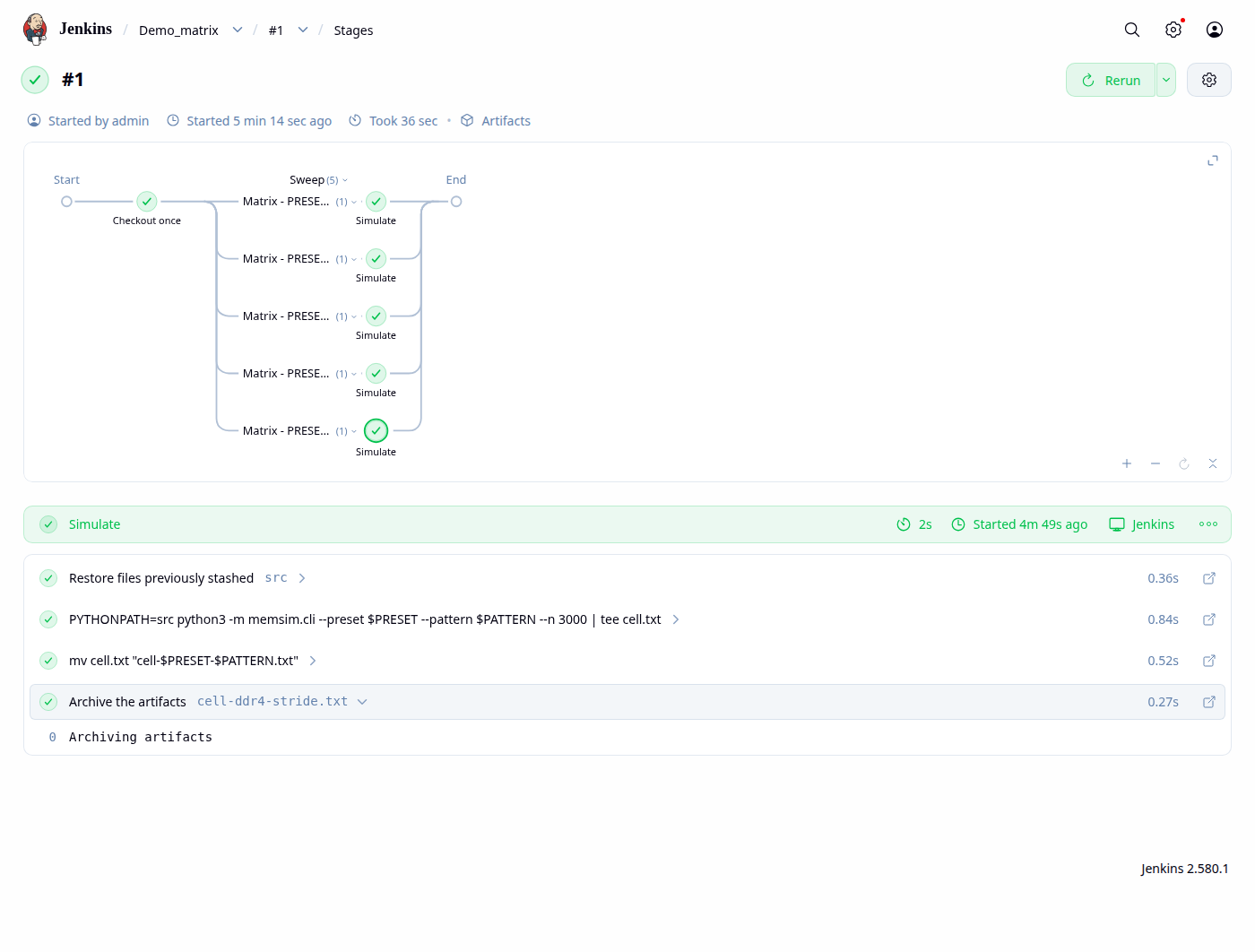
Demo_matrix #1 on the local Jenkins: two presets × three patterns, minus one excluded cell, so five cells.
05
Shared Libraries
When five repositories need the same stages, copy-paste drifts. A shared library is a Git repository of Groovy that pipelines load by name. A file in vars/ becomes a step. This one gives any simulator the house regression stages:
snippets/t07/library.Jenkinsfile (ran as Demo_library #1) source
@Library('simeng-ci') _
node('sim') {
git url: 'https://github.com/BrendanJamesLynskey/Memory_System_Sim.git', branch: 'main'simRegression(gate: 'ci/perf_gate.py --margin 0.5', results: 'examples/results.py',
resultsFile: 'examples/results.md')
stage('Publish (credential demo)') {
withCredentials([string(credentialsId: 'results-upload-token', variable: 'TOKEN')]) {
// The token is masked wherever it would be printed.sh'echo "would upload results.md with token $TOKEN"'
}
}
}
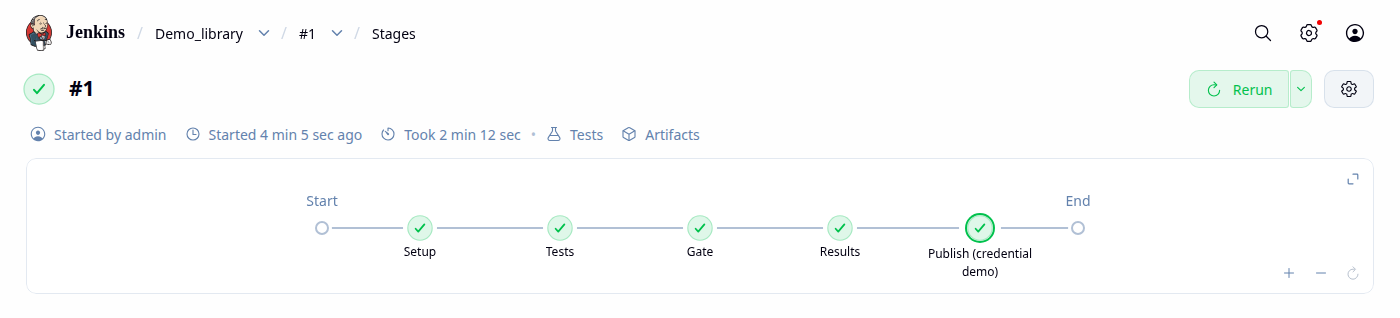
The library is configured once on the controller, with its repository and default version. The log opens with Loading library simeng-ci@main, and the stages it defined ran Memory_System_Sim's 31 tests and its gate. Pin a library to a tag in production pipelines, so a library change cannot break every build at once.
06
Test and Coverage Reports
Every test framework in this series writes JUnit XML (pytest, cargo-nextest, GoogleTest, cocotb's runner) and every coverage tool Cobertura XML (pytest-cov, cargo-llvm-cov). Jenkins reads both, keeps their history and draws trends (deck 06, slide 13):
stage('Coverage') {
steps {
sh(env.WITH_CARGO + 'cargo llvm-cov --release --cobertura --output-path coverage.xml')
// cargo-llvm-cov lists each generic instantiation as its own method, and the// Coverage plugin's Cobertura parser rejects duplicate names: skip them.recordCoverage(tools: [[parser: 'COBERTURA', pattern: 'coverage.xml']],
sourceCodeRetention: 'LAST_BUILD', ignoreParsingErrors: true)
}
}
Rust_DES_Kernel/Jenkinsfile: the first stage, added after build #4 source
// The workspace is reused between builds (it keeps the virtualenv and build caches), so// delete the previous build's reports first. Without this a build that fails before its// tests run publishes the last build's JUnit results as its own (Rust_DES_Kernel #4 did).stage('Clean reports') {
steps {
sh'rm -f target/nextest/ci/junit.xml pytest-junit.xml coverage.xml perf_report.md sweep.csv'
}
}
junit in post { always { } }, so failing tests are still recorded: the reports matter most on a red build.
recordCoverage (the Coverage plugin). Rust_DES_Kernel's first build failed here: cargo-llvm-cov lists each generic instantiation as its own method, and the Cobertura parser rejected the duplicates. ignoreParsingErrors: true was the fix.
Delete old reports at the start of a build. Rust_DES_Kernel's build #4 failed before its Python tests ran, yet Jenkins recorded all 46 tests: the workspace is reused, and the post step found build #3's pytest-junit.xml (its suite is timestamped 13 hours earlier). A failed build that reports passing tests is worse than one that reports none. Fixed on 2026-10-03: all five Jenkinsfiles now start by deleting their report files (below). cleanWs() would also work, but it would throw away the cached virtualenv and build directories. The next failure, #7, reported its own 15 failed tests out of 47.
A reused workspace can also hide stale dependencies. #7 and #8 failed because the workspace's virtualenv still held the Python reference simulator from GitHub at an older commit. pip treats an installed git dependency with an unchanged version number as satisfied. GitHub Actions starts from scratch and passed the same commit. Force-reinstalling that dependency on every build fixed it, and #9 and #10 passed. Cache the expensive parts of a workspace, not the parts under test.
Archive what the reports are made of (results.md, perf_report.md, sweep.csv), so a number in a report can be traced to the build that produced it.
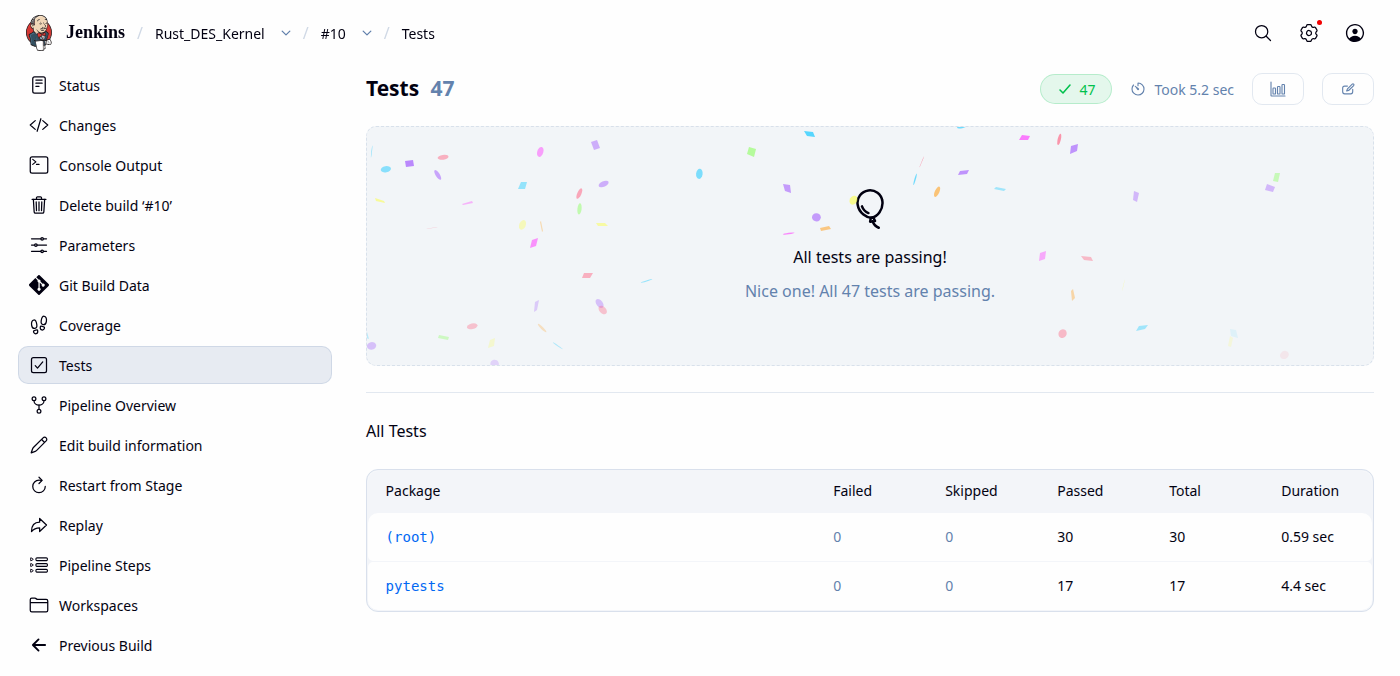
Rust_DES_Kernel #10: 47 tests from two frameworks, one report.
07
Nightly Regressions and Parameters
Fast checks run on every change; the expensive ones (seed sweeps, load-latency curves, quantum sweeps, every model at every length) run nightly. One Jenkinsfile can serve both through a parameter:
parameters {
    booleanParam(name: 'NIGHTLY', defaultValue: false, description: 'Also run the model x length sweep')
    string(name: 'PERF_MARGIN', defaultValue: '0.5',
           description: 'Allowed slow-down of trace capture against ci/perf_baseline.json')
}
A nightly job (or a triggers { cron('H 2 * * *') } block; H spreads jobs across the hour) sets NIGHTLY=true. The jobs here were triggered through the REST API.
Parameter gotchas, both met here: a parameter default computed from env becomes the text null (resolve paths in the step's shell instead), and once a job has parameters a plain /build request is rejected with HTTP 400; use /buildWithParameters.
Nightly results are artefacts too: each repository's sweep writes a CSV that the next morning's comparison can diff.
Concepts used here, and where they are explained. Each links to a glossary entry: this series glossary, or the glossaries of LLM Inference Simulators and FHE Accelerator Simulators for concepts those series already explain.
A gate is a stage that compares this build with a stored baseline and fails the build if it got worse. For a simulator there are three kinds, and these repositories use all three:
Kind
Compared
Tolerance
Example
Exact behaviour
Numbers the model must reproduce
None: any change fails, and is re-blessed on purpose
RTL cycle counts; memsim efficiencies; simfront FLOPs and weight bytes
Speed
Wall time or events per second
A margin (25–50% here), best of several runs
criterion benchmarks; capture time; requests per second
Drift
Numbers that may legitimately change
Reported, not failed (unless --strict)
Operator counts after a PyTorch upgrade
Torch_Sim_Frontend/ci/perf_gate.py: one gate, three kinds of check source
defcompare(base: dict, now: dict, margin: float, strict: bool = False) -> tuple[list[str], int]:
"""The gate's verdict: (report lines, number of failures)."""
lines = ["# simfront gate", "", "| check | baseline | now | verdict |", "|---|---|---|---|"]
bad = 0for k, b in base["traces"].items():
n = now["traces"][k]
for f in ("flops", "weight_bytes"):
ok = n[f] == b[f]
bad += not ok
lines.append(f"| {k}: {f} | {b[f]:,} | {n[f]:,} | {'ok' if ok else 'CHANGED'} |")
for f in ("ops", "bytes"):
ok = n[f] == b[f]
bad += strict andnot ok
lines.append(f"| {k}: {f} | {b[f]:,} | {n[f]:,} | {'ok' if ok else 'drift (framework)'} |")
b, n = base["capture_s"], now["capture_s"]
ok = n <= (1 + margin) * b
bad += not ok
lines.append(f"| capture llama3-8b prefill 2048 (s) | {b:.3f} | {n:.3f} | {'ok' if ok else 'SLOWER'} "
f"(margin {margin:.0%}) |")
return lines, bad
The gate is itself tested: a test changes one FLOP in a copy of the baseline and checks the gate fails (deck 09). A speed gate on a shared machine needs a generous margin and best-of-N timing, or it will be flaky (deck 11).
09
Credentials
Pipelines need secrets: a token to publish results, a licence server, an SSH key for a lab machine. Jenkins stores them encrypted on the controller, and a pipeline refers to them by ID. withCredentials binds one to an environment variable for a block, and masks its value in the log:
stage('Publish (credential demo)') {
withCredentials([string(credentialsId: 'results-upload-token', variable: 'TOKEN')]) {
// The token is masked wherever it would be printed.sh'echo "would upload results.md with token $TOKEN"'
}
}
Loading library simeng-ci@main
============================= 31 passed in 17.29s ==============================
Masking supported pattern matches of $TOKEN
+ echo would upload results.md with token ****
would upload results.md with token ****
The credential here is a demo string, not a real token. The log shows **** where its value would be.
Use single quotes in sh so the shell expands $TOKEN. Groovy interpolation ("$TOKEN" in double quotes) puts the secret into the command line itself, and Jenkins warns about it.
Masking is a safety net, not a guarantee: a secret that is transformed (base64, split, hashed) is no longer recognised. Scope credentials to the folders that need them.
10
Interactive: Every Build, and Why Some Failed
Every build on the local Jenkins, from its API. Choose a job to see its builds; the failures are where the lessons were.
Durations and results from the Jenkins API, recorded in snippets/RESULTS.md.
11
The Real Runs
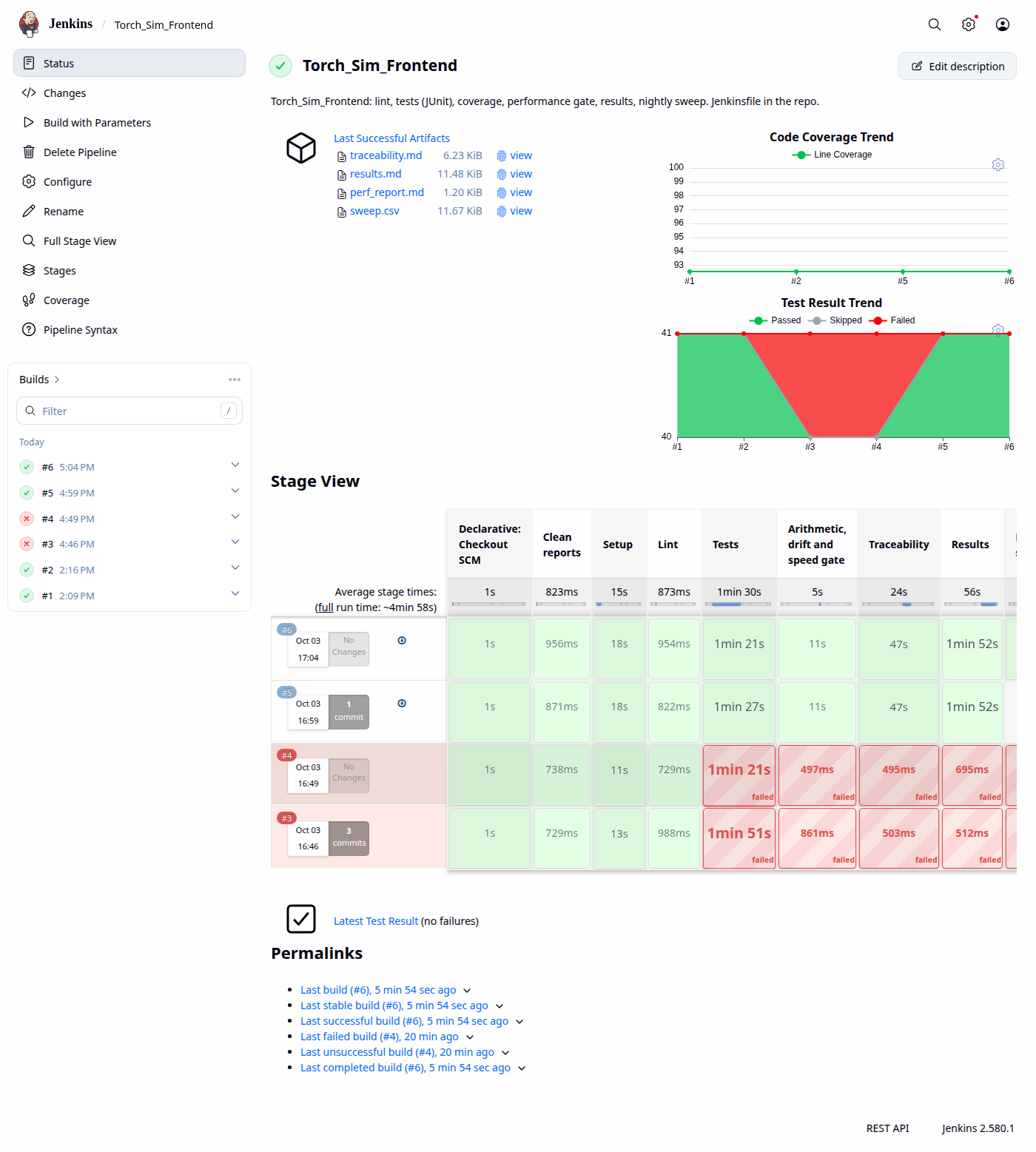
Each job's page: the last artefacts, the coverage and test-result trends, and the stage view, one row per build. Choose a repository:
Before any of these ran, each Jenkinsfile was checked by the declarative linter (POST /pipeline-model-converter/validate), which also catches typos that would otherwise surface only at run time:
Every repository here uses both: GitHub Actions on every push, Jenkins for the full pipeline with its gates and nightly sweeps. They suit different jobs:
Jenkins
GitHub Actions
Where it runs
Your controller and agents: on site, next to licences, lab hardware and big machines
Hosted runners (or self-hosted ones you register)
Pipeline definition
Groovy Jenkinsfile, shared libraries
YAML workflows, reusable actions and workflows
Reports and trends
Plugins keep test, coverage and artefact history per job
Logs and artefacts per run; trends need extra tooling
Cost of ownership
You run, upgrade and secure it, plugins included
Little to run; minutes and runner sizes are the limits
Typical in hardware teams
Regressions that need EDA tools, licences or boards
Open-source code, quick checks, public CI
The GitHub Actions workflows here run the tests on Python 3.10 and 3.12, the Verilator and Icarus matrix and the sanitizer builds, and every one passes on GitHub.
The Jenkins here is local only: its pages are not reachable from outside, and it has no separate agents. The screenshots on slides 04, 05, 06 and 11 are of its real runs.